
Why the modern workday needs better equipment
Hybrid, sedentary, and split across offices and homes — your team’s setup looks nothing like it did five years ago, and most fitness gear hasn’t caught up.
According to the U.S. Bureau of Labor Statistics, civilian workers in 2025 spent an average of 3.55 hours per workday sitting and 4.14 hours standing. Overall, this represented 44.9% of the workday spent sitting and 55.1% standing [1].
That single statistic reshapes the wellness conversation. The problem is not whether employees occasionally exercise; it is whether the workday itself moves them at all.
The 2024 Employee Wellness Industry Trends Report found that 28% of surveyed benefits brokers expected employers to increase investment in reimbursements, potentially covering fitness equipment and other wellness expenses [2]. This points to growing demand for flexible, employee-directed wellness benefits. For distributed and hybrid teams, that also means choosing equipment that works across locations.
BetterMe’s corporate equipment catalog is built for exactly that need. It includes premium fitness equipment, wholesale yoga mats, desk exercise equipment, and on-site tools suitable for a dedicated office gym, a hot-desk wellness corner, or a remote employee’s living room. This guide walks through the catalog by use case, helping HR and Workplace teams match equipment to employees without overbuying—or buying twice.
Movement Essentials
If you are equipping a corporate wellness room, a yoga month, or a movement-focused offsite, mats and bands are the foundation. They are also the most-shared piece of fitness equipment in any workplace — which means quality, hygiene, and consistency matter more than they would for personal gear. The bundles below are designed for bulk distribution, repeated use across teammates, and storage in compact wellness corners.
Mat & Strap Bundle — the foundation for any wellness space
The Mat & Strap Bundle pairs a premium non-slip yoga mat with an alignment strap, sized for guided yoga, pilates, mobility, and stretching sessions of every level. The mat itself is built to a thickness and density that supports both grounded postures and standing flows, with a textured surface that holds traction even during longer sessions. The strap turns the same mat into a flexibility and assisted-stretch tool — extending hamstring openers, supporting bound postures, and giving newer practitioners a way to ease into deeper poses without risk of slipping.
For HR teams, the bundle is the simplest way to buy wholesale yoga mats with a tool that actually expands what employees can do on them. One bundle per active employee, plus a small reserve in the office wellness room, is enough to launch a full yoga or mobility program without a second procurement cycle.
Weight Bands — strength training without the floor space
Resistance bands are the most space-efficient strength tool in the catalog. A set of weight bands replaces a rack of dumbbells for most full-body workouts, fits inside a desk drawer, and ships at a fraction of the freight cost of fixed-weight equipment. That makes them a natural fit for two scenarios at once: equipping a corporate gym or wellness room with shared sets, and shipping individual sets to remote employees so the home and office workouts use identical gear.
The bands are graded across resistance levels so the same set works for newcomers and experienced lifters. For program design, that grading matters — a single product covers a wide range of fitness baselines, which keeps the catalog short and the experience consistent across departments and regions.
Body Bar — full-body movement with a single tool
The Body Bar is a weighted bar designed for low-impact, high-quality movement: shoulder mobility work, pilates-style flows, balance training, and light strength conditioning. It is the kind of piece of fitness equipment that earns its space because it does several jobs well — warm-ups, mobility resets, full-body strength flows — without dedicated weight plates or barbell setup.
For corporate wellness rooms, a small set of body bars (typically four to eight, depending on headcount) supports group classes, lunchtime mobility sessions, and self-guided routines without overcrowding the floor. For HR teams running on-site fitness moments, the body bar is the lowest-friction way to move from "yoga month" to "strength + mobility month" without rebuilding the room.

The best work anniversary gifts aren't measured by their price tag. They're measured by whether the employee still uses them six months later.
Equipment alone is a great start. What turns it into a measurable benefit is the program that sits behind it — guided yoga, mobility, strength, and meditation content employees can actually follow on the mat. BetterMe's Wellness Program pairs the gear with structured workouts, in-app coaching, and HR-facing engagement reports, so the wholesale yoga mats are not just delivered — they are used.
Desk Exercise Equipment for Active Workdays
For most knowledge workers, the eight-hour shift is functionally a sitting shift. The BLS data on sitting time¹ is one signal; the other is what employees actually feel — stiff hips, rounded shoulders, low afternoon energy, and the slow accumulation of the kind of strain that builds over months of sedentary work. Sometimes, the fix is not a complete training program. It is the right small piece of equipment within arm's reach, used for two to five minutes between meetings.
That is the design brief for desk exercise equipment. It has to be compact, quiet, safe to use in office clothes, and effective in short bursts. The two products below sit at the top of the catalog because they meet all four criteria.
Soft Pilates Ball — five-minute resets at the desk
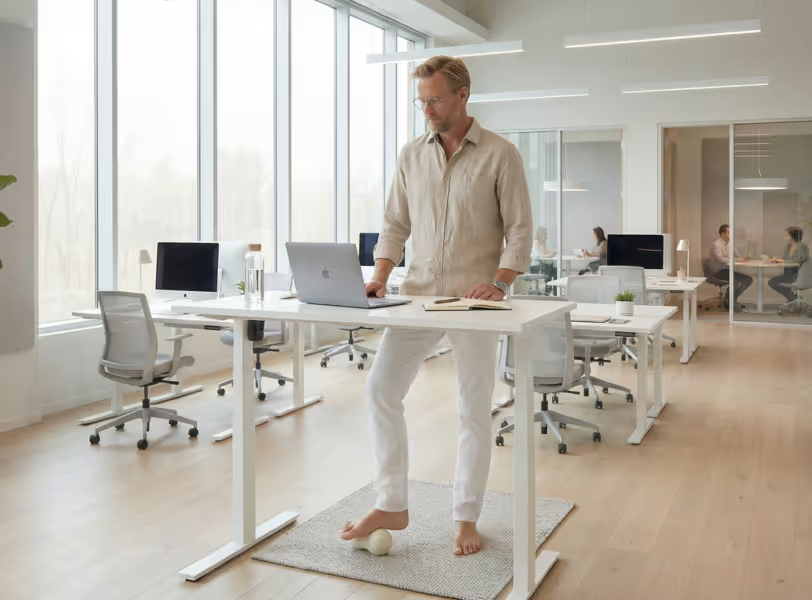
The Soft Pilates Ball is the most under-rated piece of desk exercise equipment a workplace can buy. Squeezed between the knees, it activates the inner thighs and core during standing meetings. Pressed against the lower back in a chair, it doubles as a postural support that prompts the back into a more neutral position. Used on the mat, it adds resistance to glute bridges, ab work, and shoulder-blade exercises that office workers rarely do otherwise.
It is also the easiest item to ship to remote employees. The ball deflates for shipping, inflates in under a minute, and stores under a desk between uses. For distributed teams, that combination turns a small SKU into a practical wellness touchpoint — a five-minute movement break that does not require changing clothes or leaving the desk.
Sculpt Weight Loop — strength training between meetings
The Sculpt Weight Loop is a closed-loop resistance band engineered for compound lower-body movements: glute bridges, lateral walks, squats, and standing leg work. For employees who spend most of the day seated, it helps target muscles that are not engaged while sitting, including the glutes and hips. Five minutes of looped movement between meetings reactivates them and noticeably helps reduces the late-afternoon stiffness sedentary work tends to build.
Like the Pilates ball, the weight loop fits into a small drawer and ships in an envelope, which is why it works as both office gear and remote-employee gear. For HR teams who want one consistent kit across hybrid setups, the Pilates ball + weight loop pair is a strong starting bundle: under $100 of gear per employee, no on-site footprint, and a noticeable difference in how the workday feels.
How to integrate desk exercise equipment into the workday
The gear only works if the rhythm works. Most successful programs combine three things: a small piece of equipment within arm's reach, a guided five-minute movement break in the calendar, and a manager-led norm that says the break is encouraged. BetterMe's wellness platform supplies the guided breaks; the desk exercise equipment supplies the tools; the HR program supplies the cultural permission. Together, they flip a sedentary workday into an active one without adding meetings to the calendar.
Equipment alone is a great start. What turns it into a measurable benefit is the program that sits behind it — guided yoga, mobility, strength, and meditation content employees can actually follow on the mat. BetterMe's Wellness Program pairs the gear with structured workouts, in-app coaching, and HR-facing engagement reports, so the wholesale yoga mats are not just delivered — they are used.


Build a desk wellness kit your employees will love
Create a wellness experience employees will actually use — from onboarding to everyday work routines
Recovery Gear for Corporate Wellness Spaces
Wellness rooms are no longer a perk reserved for tech campuses. As benefits budgets shift toward equipment and movement support², a growing share of offices are setting aside a small footprint — sometimes just an unused conference room — for recovery, mobility, and quiet movement. The most effective recovery rooms share a short list of equipment: foam rollers, massage balls, and a clean floor with a mat or two. Everything else is optional.
Foam Rollers — the centerpiece of any recovery room
Foam rollers are the workhorse of corporate recovery gear. A 60–90 cm roller can be used for controlled pressure on the upper back, glutes, strength, IT bands, and calves — the four areas that tighten the most under desk work. Five minutes on the roller before a meeting often does more for posture and energy than a full coffee break. For shared corporate gym equipment, density and durability matter; the rollers in BetterMe's catalog are built for repeated, multi-user wear without losing shape.
For room sizing, a useful rule of thumb is one roller for every 10–15 active employees in the building, plus one or two reserves. That is enough capacity for lunchtime peaks without overcrowding the floor. Smaller satellite offices typically need two rollers and a few mats — the minimum viable all-day sitting recovery corner.
Massage Balls — targeted mobility support for desk-heavy roles
Massage balls target all the areas foam rollers cannot reach: the upper traps, scapula, glute medius, plantar fascia, and the tight knot under the shoulder blade that builds up after a day of typing. A small set of massage balls — single-sphere and dual-sphere — covers the full map of common desk-related tightness. Each ball is small enough to live in a drawer; together, they make the recovery room work for a wider range of bodies.
Massage balls also travel well. For HR teams running on-site events, offsites, or pop-up wellness moments, a small box of balls is the easiest piece of corporate fitness equipment to bring along. They double as a take-home prize for participants — a tiny gift that keeps the wellness habit alive long after the event.
Steps
How to set up an office-friendly corner
Most teams move from idea to a live wellness spaces in three steps.
Step 1
Pick the footprint
Decide whether you are kitting out a dedicated wellness room, a shared corner of an open floor, or a hybrid setup that ships gear to remote employees. Each scenario has a different bundle in the BetterMe catalog.
Step 2
Match equipment to headcount
Share rough headcount, geography, and how many days a week the office is at peak occupancy. The B2B team will scope quantities, customization, and shipping around your specifics.
Step 3
Connect it to a program
A 30-minute working call confirms the equipment list, the rollout plan, and how the BetterMe Wellness Program plugs into the gear — guided sessions, recovery routines, and engagement reporting that turn the space into a measurable benefit.